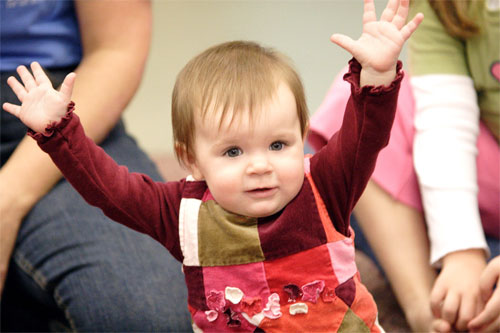
Movement and Music: Together

Years ago, although I was happily attending a Music Together class and had even trained to become a teacher, I embraced the belief of so many first-time parents—that there is no such thing as too much enrichment for one’s child. So I enrolled my daughter in a second music program as well. In this program, the children either sat in a circle and sang simple melodies or got up and moved rhythmically to piano music. My two-and-a-half-year-old often stood during the sit ‘n’ sing parts and moved quite energetically, despite the teacher’s baleful glances and my urgent whispers. When her energy level escalated enough to propel her around the circle, the frustrated teacher was sometimes reduced to tackling her.
O, Reader, as the parent of this child, I fully sympathized with the teacher’s predicament; but as a Music Together veteran, I was unused to the idea of her having to sit during a music experience. With missionary zeal, I approached the head of the program and offered to share a few song ideas. He welcomed me and followed my lead as we tapped our feet and chanted “There’s a Cobbler,” made precipitous turns and honked our imaginary horns as we went “Ridin’ in the Car,” and tapped our knees and noses as we sang “Biddy Biddy.” But when I encouraged him to put on his bunny ears and become “John the Rabbit” with me, he blurted out, “Do all your songs have these . . . movements that go with them?”
From his perspective, movement was a distraction to learning a song; it was important that a child sit in the circle and pay attention. My Music Together training, however, had taught me that music and movement go together. Certainly my daughter’s immediate response to music was to move rhythmically. But, I couldn’t help wondering, did she have to be so rhythmic? At the time, I thought she was too young or maybe even too stubborn to follow the protocol of this class, but now I understand she was instinctively sticking with a behavior guaranteed to foster her music development. Her full-body boogie, which felt like a problem for the adults around her, was helping her develop rhythm competence through experiencing and expressing music physically.
Movement is a vital developmental tool for children. It seems natural to us that an infant moves his limbs, turns his head, and flexes his tiny fingers, but we don’t often consider that this is the process by which the child develops his ability to coordinate his mind and body. The very act of moving stimulates his muscles and his neural pathways, helping both to develop the capacity to communicate with each other. Just as a person with a leg in a cast will find those muscles slightly atrophied when the cast comes off, so would an immobilized child be hindered in reaching her full capacity for movement. In other words, the child’s increasing mastery of her body’s movements comes not just from physical growth, but from the stimulation provided by the movement/mind feedback loop.
This kinesthetic feedback mechanism is also essential to developing rhythmic competence in music. “Movement is an experiential path-way to cognition for children,” says Kenneth K. Guilmartin, Music Together founder/director and coauthor. “In order to ‘decode’ the music rhythms of our culture, the child needs to explore them freely in her body.” Rhythm, when expressed in movement, becomes a conduit for the flow of information between the eye, ear, body, mind, and emotions, and greatly enhances the ability to understand and to love music. Therefore, we generally don’t require children to sit still in a Music Together class (although each teacher judges her class’s tolerance for over-exuberant behavior and sets guidelines). We know this would actually interfere with their ability to express increasingly sophisticated responses to music stimuli. Children are learning on an elemental, physical level, literally getting the music “into their bodies.”
They teach themselves through a level of repetition we adults would likely find exhausting. (Do we endlessly practice a golf swing or yoga position as cheerfully and singlemindedly as a child attempts to stand?) For a child, movement is sheer fun, whether skillfully or clumsily executed, and she wants to try it again and again and again. It is nature’s wonderful economy to ensure that what is best for the child is what he so naturally wishes to do.
How is it, then, that some children have no trouble sitting still when experiencing music? It can be a matter of temperament or of development whether they choose to move in class. The child with the more visual learning style may be focused on tracking the rhythmic movements of others in the class, storing it in his music memory for later exploration and play at home. Older children, on the cusp of basic music competence, may suddenly move less because they are increasingly able to audiate, that is, to hear and understand music in their mind when it’s not physically present. More and more, they notice the ways that their tonal and rhythmic expression doesn’t quite match what they hear both in their mind and from the adults around them, and they become interested in attending more closely in class.
However, even if we’re not moving, we’re really not quite still either, according to Dr. Lili Levinowitz, coauthor of Music Together and Director of Research. “While one audiates, the body is moving at the micro- muscular level. That is, electrical impulses are sent to the muscles. The pathways for the micro-muscular movement are formed in early childhood, so movement is absolutely essential to the development of rhythmic audiation.”
In other words, the act of moving itself pro-vides the information a child needs for rhythm learning, and this movement becomes imprinted in our muscles and neural pathways. As the child’s movements become more refined and precise over time, they become distilled at the micro-muscular level, where we always experience movement whenever we experience music. Music and movement really do go together in a most elemental way.
My child and I didn’t stay in the local music program, but in subsequent years, when I was the director of a large Music Together center, I regularly sent my older graduates there. I could see they had a level of readiness, both musically and developmentally, to sit and pay attention. And my daughter? She still sways and bobs and taps when she learns a song, but she stands admirably still when she sings in the school chorus.
—Susan Pujdak Hoffman, staff writer and Certified Music Together Trainer